

Germany Quantum Computing Advanced Packaging Market Grows; Intel, Amkor Lead
Quantum Computing Advanced Packaging Market
Industrial standardization and R&D investments drive rapid expansion
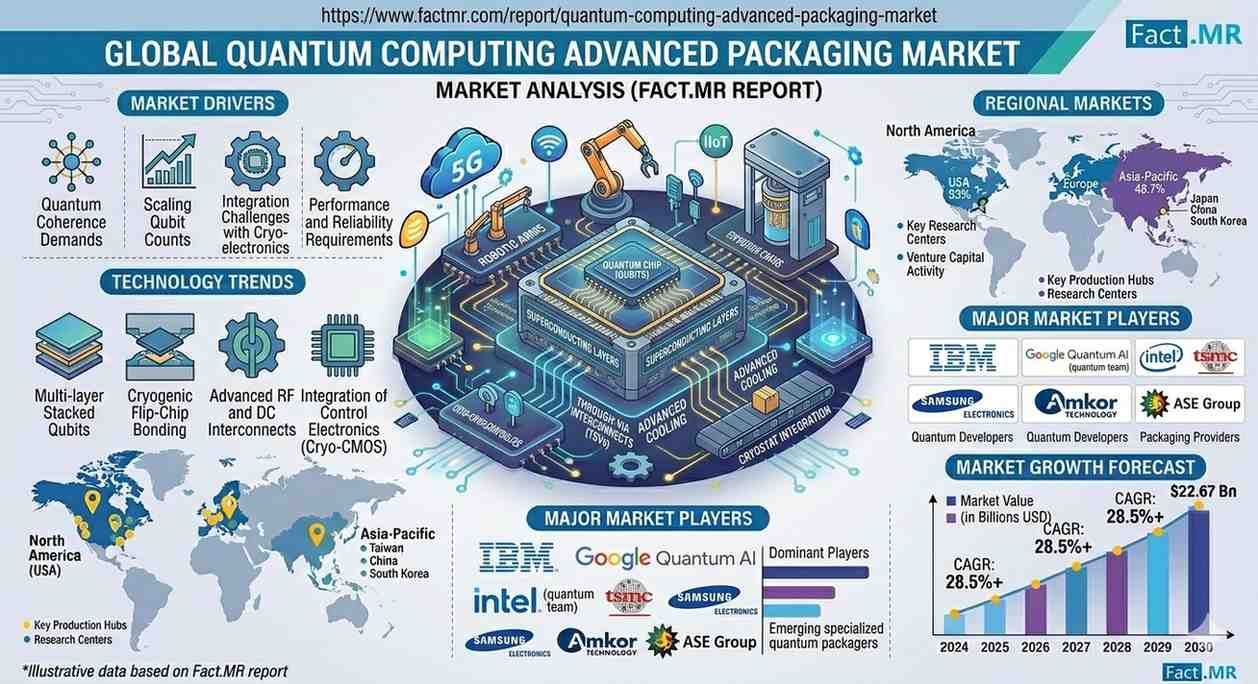
ROCKVILLE, MD, UNITED STATES, April 17, 2026 /EINPresswire.com/ -- The German quantum computing advanced packaging market is entering a pivotal phase of industrialization. According to the latest analysis by Fact.MR, the market is projected to total USD 91.10 million in 2026, advancing to USD 278.65 million by 2036. This growth reflects an impressive 11.4% CAGR, driven by Germany’s unique focus on transitioning quantum processors from fragile laboratory prototypes into robust, repeatable, and scalable industrial systems.As quantum processors move closer to commercial viability, conventional integrated circuit (IC) packaging has proven inadequate. The extreme sensitivity of quantum states to environmental noise, coupled with the necessity to integrate thousands of control and readout lines into cryogenic environments, has positioned advanced packaging as the critical enabler—and potential bottleneck—for the entire German quantum ecosystem.
Get detailed market forecasts, competitive benchmarking, and pricing trends:
https://www.factmr.com/connectus/sample?flag=S&rep_id=13416
Quick Stats: Germany Quantum Computing Advanced Packaging
Metric
Value
Market Value (2026)
USD 91.10 Million
Market Forecast Value (2036)
USD 278.65 Million
Forecast CAGR (2026–2036)
11.4%
Leading Qubit Segment
Superconducting (45%)
Leading Package Type
2.5D Interposer (48%)
Primary Customer
Research Labs (50%)
Key Market Players
ASE Technology, Amkor, Intel Foundry, TSMC, Samsung, JCET
Executive Insight for Decision Makers
The German market is defined by a strategic shift: moving away from "pure qubit count" toward the development of reliable, characterizable packaging platforms.
The Mandate for Manufacturers: Success in the German market requires a commitment to rigorous testing protocols and the standardization of interfaces. Manufacturers must focus on thermal management and signal integrity at millikelvin temperatures.
Risks of Not Adapting: Organizations that ignore the "cryo-compatible" manufacturing requirement will find themselves excluded from the pre-commercial quantum supply chain as standards solidify over the next decade.
Market Dynamics
Key Growth Drivers:
Industrial Research Leadership: Institutes like Fraunhofer are bridging the gap between fundamental quantum research and fab-ready manufacturing processes.
System Scaling: The critical need to manage soaring I/O density and minimize signal interference within cryogenic systems.
Standardization Initiatives: Collaborative efforts to automate assembly for complex quantum modules.
Key Restraints:
Prohibitive Costs: Specialized materials and low-volume production cycles keep entry barriers high.
Lack of Uniform Standards: The fragmentation of quantum architectures complicates the creation of a "one-size-fits-all" packaging solution.
Segment Analysis: The Path to Scalability
Superconducting Qubits (45% share): As the front-runner for gate-based processors, this segment drives the immediate demand for packaging that operates reliably at cryogenic temperatures.
5D Interposer Packaging (48% share): This architecture serves as the foundation for complex quantum-classical integration, allowing for the side-by-side attachment of quantum dies and classical control ASICs.
Research Labs (50% share): While commercial interest is rising, academic and national laboratories remain the primary drivers, as they require the highly customized, low-volume solutions that define current performance standards.
Supply Chain Analysis: Who Supplies Whom
The supply chain is moving toward deep collaboration between hardware innovators and packaging leaders:
Raw Material/Substrate Suppliers: Precision engineering firms provide ceramic and silicon interposers with minimal dielectric loss.
Manufacturers (OSATs): Companies like ASE Technology and Amkor are adapting their advanced toolkits to cryogenic requirements.
Foundries:Intel Foundry Services and TSMC are offering full-stack integration, combining quantum IP with manufacturing scale.
End-Users: Quantum hardware companies and industrial consortia utilize these services to stabilize qubit coherence and enable system expansion.
Strategic Takeaways
For Manufacturers: Prioritize the co-design of qubits and packages to improve overall system yield and reduce signal loss.
For Investors: Target early-stage partnerships between specialized quantum hardware startups and established OSAT players who possess the infrastructure for mass production.
For Marketers/Distributors: Focus on "industrial-grade reliability" and "standardization" as key value propositions in the German market.
Future Outlook: The Road to 2036
The market is heading toward the formation of a dedicated "Quantum Foundry" ecosystem. Technology impact will be dominated by modular, multi-chiplet platforms that allow for rapid prototyping. Long-term, the opportunity lies in the transition from bespoke, one-off packaging to automated, high-yield production lines that mirror current semiconductor standards.
Conclusion
Germany’s commitment to engineering-driven quantum development provides a blueprint for the global industry. By focusing on the robust, repeatable processes necessary to transition from lab to fab, Germany is positioning itself as a central hub for future quantum system infrastructure. The next decade will be defined by those who can successfully marry quantum innovation with semiconductor-scale manufacturing.
Why This Market Matters:
Advanced packaging is the unsung hero of the quantum revolution. Without the ability to preserve qubit coherence through sophisticated thermal and signal management, quantum computers cannot scale. Packaging is the bridge between theoretical quantum advantage and real-world computational power.
Full Report: Unlock 360° insights for strategic decision making and investment planning-
https://www.factmr.com/checkout/13416
To View Related Report:
Packaging Testing Services Market https://www.factmr.com/report/packaging-testing-services-market
Packaging Conveyors Market https://www.factmr.com/report/627/packaging-conveyors-market
Sleeve Packaging for Extrusions Market https://www.factmr.com/report/sleeve-packaging-for-extrusions-market
Mailer Packaging Market https://www.factmr.com/report/mailer-packaging-market
S. N. Jha
Fact.MR
+1 628-251-1583
email us here
Legal Disclaimer:
EIN Presswire provides this news content "as is" without warranty of any kind. We do not accept any responsibility or liability for the accuracy, content, images, videos, licenses, completeness, legality, or reliability of the information contained in this article. If you have any complaints or copyright issues related to this article, kindly contact the author above.
